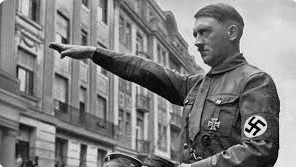
At risk of joining crowds of journalists who cannot give up the thrill of covering Trump nearly a year after his departure, allow this brief analysis of the tiresome and oft-repeated slogan: Trump is like Hitler. If a New York Times Best-Seller list existed for mantras, this would have been at its top during Trump’s presidency. It was repeated over and over, often by serious individuals who ought to have had the intellectual grounding to resist the tide of Nazi comparisons that swept popular culture.
Those who bothered to support the bombastic claim did so dishonestly—or in the least ineptly—and in so doing promoted a theory of guilt through which any person could be indicted. Accusations of Trump’s Hitlerian features were generally of the tenor that he undermined democratic norms, or that his immigration policies were heavy-handed and bigoted, or that his rhetoric otherized vulnerable groups. Faced with the obvious fact that these are not the reasons we despise Hitler, Trump’s accusers argue that Hitler began by exhibiting these characteristics.
For many, comparison on these grounds seems intuitively unfair, but let us state in clear terms—using a target other than Trump—why this is so. Consider the fact that Hitler passed animal welfare legislation,1 made significant environmental conservation efforts,2 and either maintained or implemented intensive social welfare programs.3 It is inappropriate to suggest (as some on the political Right have done) that modern politicians who aspire to implement related policies are like Hitler, not because it isn’t technically true in a narrow sense, but because it creates a cognitive association between the target politician and the memory of Hitler. And, of course, the memory of Hitler burned in the public conscience is of a man who murdered six million Jews. In this way, we could unfairly and illogically associate a person who supports environmental conservation and social welfare with genocide. This is, if not the intention, a predictable by-product of many Person X is like Hitler arguments.
To crystallize this idea, consider a simple Venn Diagram. A brief description for the unfamiliar: Venn Diagrams are a tool used to show differences between variables (people, concepts, places, etc.) as well areas of similarity, represented visually as overlapping circles.
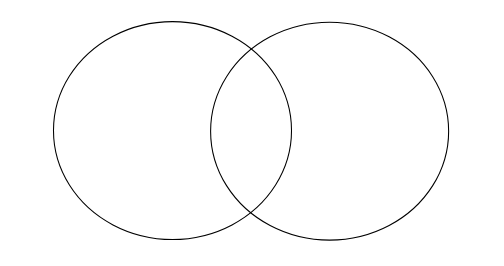
For our purposes here, each circle will represent a person. Within each circle are various characteristics, and the overlap (also called the intersection) denotes characteristics that both share. What should be apparent is that by making the intersection sufficiently vague one can cognitively associate almost any two people.
For example, if we write enjoys sweet foods in the intersection, Joe Biden could be compared to Adolf Hitler, simply on the basis that both are4/were5 known to have a sweet tooth.
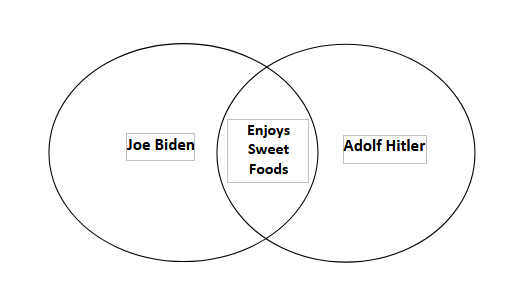
This is a facetious comparison that most would recognize as unfair, but a more serious comparison that is less obviously manipulative can be made. Let us write has publicly made racist statements in the diagram’s intersection.
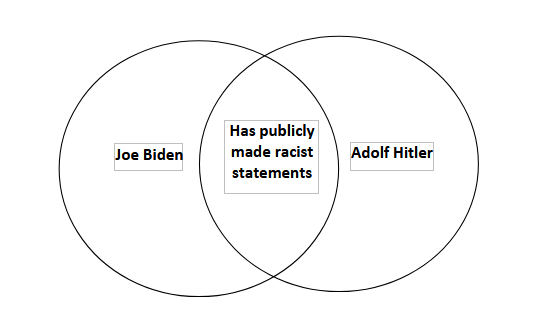
Here we have a more subtle insinuation. The intersecting trait here is indeed a sin (rather than a harmless food preference), and one could make an argument (similar to the anti-Trump argument) that although Hitler is not remembered as a villain because of racist statements, those statements were how Hitler’s movement began—which is true.
Manipulating the logic of Venn Diagrams occurs on both sides of the aisle, but the fervor with which the Left slanders Trump as similar to Hitler is unprecedented—a feat considering the energy with which conservatives labelled Obama a communist during his presidency.
We may, for the benefit of all parties, wish to establish rules for how and when we compare current politicians to the villains of history, not least because it tends to minimize the horrors of the past, but also because it creates division between political shareholders. This author would propose a simple rule: the logic of Venn diagrams should not be manipulated to use irrelevant (or minorly relevant) traits to associate individuals who are otherwise dissimilar.
The counter-argument likely to be made by those fond of making Nazi (or communist) comparisons is that we need an early-warning system for dangerous people or movements. In other words, if we wait until political figures are committing genocide to label them as villains, it will be too late to prevent atrocities. While this is true, there are two interrelated problems. The first is that it is difficult to predict accurately which figures we are prophetically naming and which ones we are baselessly slandering. The second—more dangerous and flowing from the first—is that by overusing names and terms for evil we are diluting the very language needed to label and condemn violent movements when they actually arrive.
Hitler was a moral monster who murdered six million Jews and five million others, including homosexuals, disabled individuals, and Sinti and Roma peoples.6 He killed through premeditated and vicious genocide, the scale and barbarity of which is difficult to comprehend. Suggesting a moral equivalency between Trump and Hitler, no matter the intention, shamefully minimizes these atrocities.
These types of comparisons need to stop, for the health of the body politic and the sake of logic and common decency.
- University of Guelph, “Historian Uncovers Nazi Animal Laws”, Available at: https://news.uoguelph.ca/2014/04/historian-uncovers-nazi-animal-laws/
- Uekötter, Frank (2007) “Green Nazis? Reassessing the Environmental History of Nazi Germany”, German Studies Review 30(2): 267–87.
- Cambridge University Press, “Mass Warfare and the Welfare State – Causal Mechanisms and Effects”, Available at: https://www.cambridge.org/core/journals/british-journal-of-political-science/article/mass-warfare-and-the-welfare-state-causal-mechanisms-and-effects/B2EADA1A0085689195973127E3B33394
- Mashed, “This Is What Joe Biden Really Eats”, Available at: https://www.mashed.com/236646/this-is-what-joe-biden-really-eats/
- The Atlantic, “Hitler’s Sweet Tooth”, Available at: https://www.theatlantic.com/magazine/archive/2017/09/hitlers-sweet-tooth/534207/
- British Broadcasting Corporation, “Non-Jewish Holocaust Victims: the 5,000,000 Others”, Available at: https://www.bbc.co.uk/tyne/content/articles/2005/01/20/holocaust_memorial_other_victims_feature.shtml