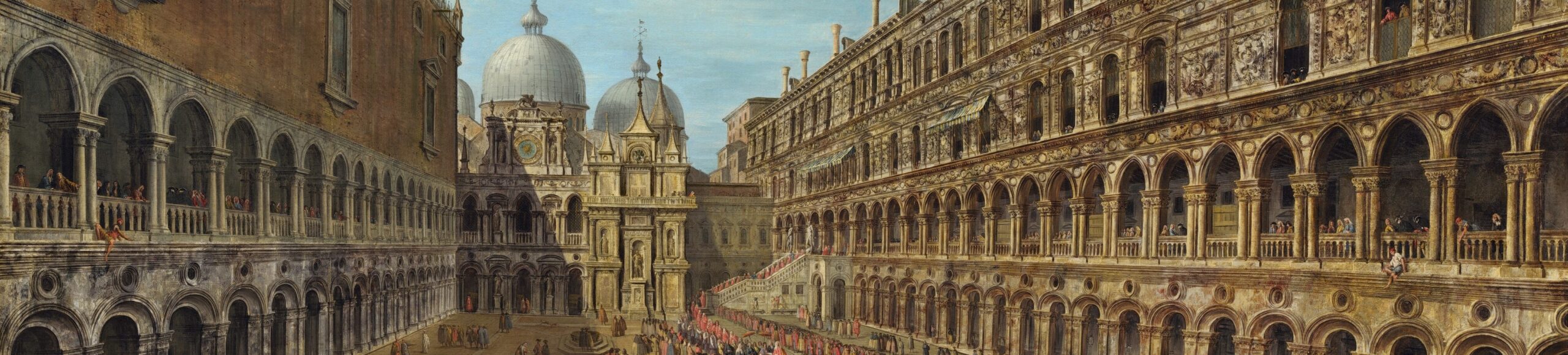

In this two part series, it is argued that the appeal of dictatorships is deeply embedded in Western thought. Part 1 discusses examples of democratic institutions or movements being discarded in favour of autocratic governance. Part 2, below, examines the ideological and intellectual foundations for non-democratic forms of governance, and in closing discusses the modern context of political decision-making and popular support.
Ideological and Intellectual Foundations
The Divine Ruler
For most of the West’s history people have been ruled by monarchy and hereditary rule. The story of the West is mostly the story of kings, heroes, and strongmen, not of gentle diplomats and democrats. The Western mind, prior to a few hundred years ago, was steeped in indoctrination for obedience to a king or oligarchic few.
An important ideological component of this model of governance in the ancient and medieval world was the argument that rulers had some connection to the divine. Rulers deserved such status because their reign was, in the case of medieval kings, endorsed by God. The divine right of kings doctrine held that the heavenly design of monarchy made disobedience not just a civic problem but a sinful act against God.23 Boak, discussing Greek rulers’ claims of divinity—different from the medievals in that they often claimed literal relationship to gods—argues that “the deification of the absolute monarch was…the bestowal of the supreme legislative power upon the ruler in a form which accorded with existing conceptions of political rights.”24 In other words, to make autocracy palpable to a culture with some sense of rights, appeals to authority (gods) were used to justify absolute power.
Erich Fromm express a similar notion, writing in On Disobedience that for “most of human history obedience has been identified with virtue and disobedience with sin” and that this message has been preached by “kings, priests, [and] feudal lords.”25 From this perspective, subordinate and submissive behaviour is a pervasive part of Western culture that stretches from the ancient world to the present.
And it is not only ancient and medieval superstitions that undergird this doctrine of obedience. Philosophers and political theorists who have examined governance models do not always agree that democracy is the optimal arrangement. Indeed, there is a long intellectual tradition in the West that endorses the utility of dictators and kings.
Intellectual Traditions Undergirding Autocracy
Perhaps the most famous analogy ever written in political philosophy is Plato’s Ship of Fools, found in his work The Republic. While commonly misunderstood and poorly summarized,26 Plato’s analogy of a ship at sea is delivered as a critique of Athenian democracy and forms part of Plato’s argument that societies should be led by philosophers. Plato’s argument against democracy and in favour of a form of enlightened oligarchy have had an enduring impact on Western thought.
Voltaire, writing in the 18th century, resumes some of these themes. First (as a disclaimer of sorts) consider that Voltaire’s defense of freedom of speech and tolerance expressed in his Treatise on Tolerance27 are fundamental to the classical liberal worldview. While Voltaire never uttered the quote most famously attributed to him—I may disapprove of what you say but I will defend to the death your right to say it—his ideas are an important part of Enlightenment thinking.
Having said this, Voltaire did not support the idea of freedom as most would understand it today and his endorsement of monarchy was a constant throughout his life. As explained by Neserius, Voltaire “never considered the people fit to govern themselves…[or] that it would be desirable to overturn the monarchy and establish a democracy.”28 Similar to Plato’s view of the average citizen, Voltaire did not think governance should fall to the layman. Plato’s ideas of philosopher kings echo in some of Voltaire’s ideas on proper governance in a monarchy.
On the topic of concentrated power, Thomas Hobbes would be saddened if his work The Leviathan was excluded. Here is one of the classics of political theory and a great work on (among other topics) social contract theory. The English Civil War—through which Hobbes lived and wrote—is a useful backdrop to his argument against governing institutions with limited power. Hobbes viewed a people without government as a state “where every man is enemy to every man…and the life of man, solitary, poore, nasty, brutish, and short.”29
For Hobbes, only a leviathan of a government with absolute power could govern effectively and prevent brutish lives for the people governed. Hobbes does not discount the possibility that this could result in abuse of power, but he insists it is an acceptable cost as “the consequences of the want of it…are much worse.”30 Man’s natural state, from this perspective, is so undesirable that less freedom is a mild inconvenience to lessen the suffering of existence.
As a final sample, the ideas of Edmund Burke—sometimes called the Father of Conservatism—echo from past to present. Perhaps best known for his work criticizing the French Revolution (which sparked a fascinating exchange between himself and Thomas Paine, the latter writing the famous “Rights of Man” in response to Burke’s work), the ideas and arguments made by Burke remain influential. It is not easy to compress his ideas on governance into a phrase or sentence, and reading his work on the French Revolution (Reflections on the Revolution in France) there is temptation to deny him the complexity he is due. To give Burke a fair reading, it is worth acknowledging that he was not necessarily opposed to all change but had concerns about the harms of revolution and “hasty reform.”31
These qualifications aside, Burke’s Reflections is an impassioned defense of monarchy. He describes the nobility in England as “a graceful ornament to the civil order” and he expresses his commitment to “an established monarchy, [and] an established aristocracy.”32 On democracy being inferior to monarchy he states that “the majority of the citizens is capable of exercising the most cruel oppressions upon the minority…[and] with much greater fury than can almost ever be apprehended from the dominion of a single scepter.”33
From Plato’s Ship of Fools to Voltaire’s unfit laymen to Hobbes’ Leviathan to Burke’s defense of monarchy, an anti-democratic trend is embedded in the intellectual lifeblood of the West. While certainly a review of pro-democracy literature would fill a great many pages, the writers here are not peripheral: they are some of the West’s greatest philosophers and thinkers. Modern individuals may be unaware or simply choose to dismiss this as a relic of a distant past, but the undercurrent of anti-democratic thought is more persuasive and seductive than is generally given credit.
The Modern Mind
Perhaps the key question in the modern context is whether the history, ideology and intellectual foundations discussed here still matter today. Are we the enlightened inheritors of deep-rooted democratic norms? Is the philosophy of limited government and individual liberty a cherished conviction? Are we protected against the temptation of autocracy? Perhaps a better question is this: do we even properly understand the self-control and ideological fortification required to maintain and propagate a system that is inefficient by design?
Consider the present circumstances of political decision-making and popular support. This author would suggest that when individuals care deeply about issues, checks and balances begin to feel like dangerous barriers to achieving necessary outcomes. Whether it is the desire to protect the environment, correct a social injustice, preserve culture and heritage, or restore a sense of lost illustriousness, if passion and conviction run high—or if circumstances appear desperate enough—they erode belief in the utility and feasibility of structural safeguards on power. This was true in ancient Greece and it is true today.
Consider—to use modern hypotheticals—if an American president violated the constitutional devolution of powers between the Federal and State governments in order to implement sweeping environmental reforms. Would the political left rally against it on the grounds of constitutional invalidity? If a Canadian prime minister permanently disregarded aspects of the Charter of Rights and Freedoms in order to stop the spread of a contagion, would the Canadian people rally for liberty? If a nationalist party in Europe extinguished the constitutional barriers that prevented the deportation of immigrants, would their right-leaning base demand the policy be reversed?
The uncomfortable truth is that a great number of people relish the idea of discarding inefficient institutions when those institutions prevent the accomplishment of deeply-held political or social goals. In tumultuous times, results accomplished often justify means taken. Moreover, this instinct is not transient or superficial but a fallback on a deep part of the West’s history, intellect and culture.
We do not revile dictators, and to pretend otherwise is to risk creating more of them.
23 Oxford Reference, “Divine Right of Kings”, Available at: https://www.oxfordreference.com/view/10.1093/acref/9780198614425.001.0001/acref-9780198614425-e-1723
24 Boak, A. E. R. (1916) “The Theoretical Basis of the Deification of Rulers in Antiquity”
25 Fromm, Erich (1963) “On Disobedience”
26 Seymour, T. D. (1902) “On Plato’s Ship of Fools”, The Classical Review 16(8): 385–88.
27 Voltaire, “Toleration and Other Essays”, E-book available on The Project Gutenberg: https://www.gutenberg.org/cache/epub/64858/pg64858-images.html
28 Neserius, Philip George (1926) “Voltaire’s Political Ideas”, The American Political Science Review 20(1): 31–51.
29 Hobbes, Thomas, “The Leviathan”, E-book available on The Project Gutenberg: Source: https://www.gutenberg.org/cache/epub/3207/pg3207-images.html#link2H_4_0248
30 Ibid
31 Freeman, Michael (1978) “Edmund Burke and the Theory of Revolution”, Political Theory 6(3): 277–97.
32 Burke, Edmund, “Reflections on the Revolution in France”, E-book available on the McMaster University website: https://socialsciences.mcmaster.ca/econ/ugcm/3ll3/burke/revfrance.pdf
33 Ibid