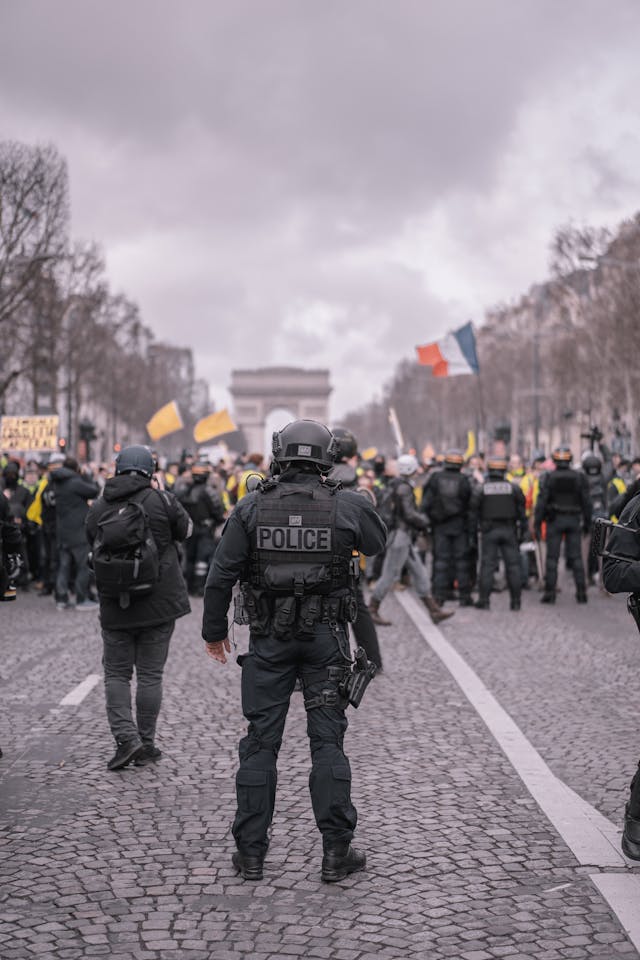
Ethnic conflict is coming to the West. It is almost a certainty in Western Europe. America, Canada and Australia are likely to follow on the same path if they do not change course. Violent clashes between migrants and working-class White people are becoming more common, and native Europeans are beginning to respond muscularly after years of abuse at the hands of migrants.
The increasing number of minority groups in Western countries commonly dislike both White people and Western civilization, and they often behave with blatant disregard for the native peoples and cultures of Europe and the Commonwealth.
But how did we get here?
Lies, mostly.
Few people in the West will be unfamiliar with the slogan diversity is a strength. It is constantly repeated by liberals and leftists, and it is often used to justify policy decisions, generally in the form of mass immigration to Europe and the Commonwealth.
Despite the weight we give to the slogan, there is little evidence to support it, either in theory or practice. While our political and media elites continue to insist on the benefits of racial, linguistic and cultural diversity, the disastrous results of this policy become clearer every day. When one looks at Western Europe and the violence and chaos brought by uncontrolled migration, it is patently obvious that diversity is not a strength at all, and that it is generally accompanied by violence and various other social issues.
We might call all this an unfortunate mistake. Perhaps our politicians and media elites genuinely believed that diversity would be good for the West? A more realistic argument, however, is that the upcoming ethnic/religious civil conflict was predictable, and that claims like diversity is a strength were a deliberate attempt to hide this.

The results of ethnolinguistic variance (or ethnolinguistic fractionalization) are well documented in academia, and we have known for years the problems that tend to accompany such population changes. The phenomenon of ethnic diversity within states was commonly studied before it became heavily politicized, so we have robust research and data upon which to rely. And as much as we would prefer to think otherwise, increased ethnolinguistic diversity is often associated with civil war and domestic violence.
There are many scholars who conclude that as diversity increases within countries the likelihood of civil war and domestic strife increase accordingly. Even scholars who argue that ethnic diversity is not an independent variable that causes civil war—civil war being the dependent variable—it is generally understood that there is still some connection between the two. As Bhavnani and Miodownik argue, “few scholars would venture so far as to argue that ethnicity is not an important factor in civil conflict.”1
Admittedly, some scholars dissent—academics rarely achieve pure consensus on such issues. Fearon and Laitin, for example, argue that ethnic and religious diversity post-Cold War did not cause civil wars, and that diversity is thus not an accurate predictor of civil strife.2
Others, however, propose a solution for such gaps in data, or what we might call a lack of predictive consistency in ethnolinguistic fractionalization models. Blime argues that even when there are non-racial variables known to cause civil war, “the likelihood of civil war onset will have a greater probability of causing war in states with higher levels of ethnic fractionalization.”3 Imagine that Variable X is a non-ethnic variable that predicts civil war—resource scarcity, low per-capita income, etc. If these variables are present in two countries, the homogenous country is less likely to experience civil war and the heterogenous country is more likely to experience civil war. Diversity is not off the hook, then, even when not the direct cause of civil war.
Based on the rhetoric coming from mainstream liberals, however, one would think universal consensus existed among academics that a) diversity is a positive good for society and b) ethnic fractionalization does not cause civil strife.
In reality, much of the evidence points in the opposite direction. Diversity is very likely a contributor to civil war and violence and, at best, the evidence is dangerously inconclusive. Certainly, there is no review of the literature that exonerates diversity and proves it is a positive policy goal for Western nations.
So what conclusions can we draw?
To start, our political and media elites have no legitimate basis for claiming that mass immigration and diversity will benefit the West. Moreover, there is concerning evidence in the academic literature that diversity is a net negative for countries. And, finally, the real-world outcomes we have observed over the past few decades, particularly in Europe, should erase any doubt regarding the problems caused by increasing levels of immigration.
And yet our elites continue to claim that diversity is a strength, holding the line on a highly questionable claim they have made for years.
It is difficult not to conclude that the flooding of Western nations with endless migration could be a deliberate attempt to cause chaos and violence, erode social cohesion and trust, and place Europe and the Commonwealth on a path toward cultural and ethnic suicide.
The reasons why may become clear over the coming decades.
Sources:
1. Ravi Bhavnani and Dan Miodownik, “Ethnic Polarization, Ethnic Salience, and Civil War,” The Journal of Conflict Resolution 53, no. 1 (2009): 33, http://www.jstor.org/stable/27638652.
2. James D. Fearon and David D. Laitin, “Ethnicity, Insurgency, and Civil War,” The American Political Science Review 97, no. 1 (2003): 75–90, http://www.jstor.org/stable/3118222.
3. Randall J. Blimes, “The Indirect Effect of Ethnic Heterogeneity on the Likelihood of Civil War Onset,” The Journal of Conflict Resolution 50, no. 4 (2006): 539, http://www.jstor.org/stable/27638505.