
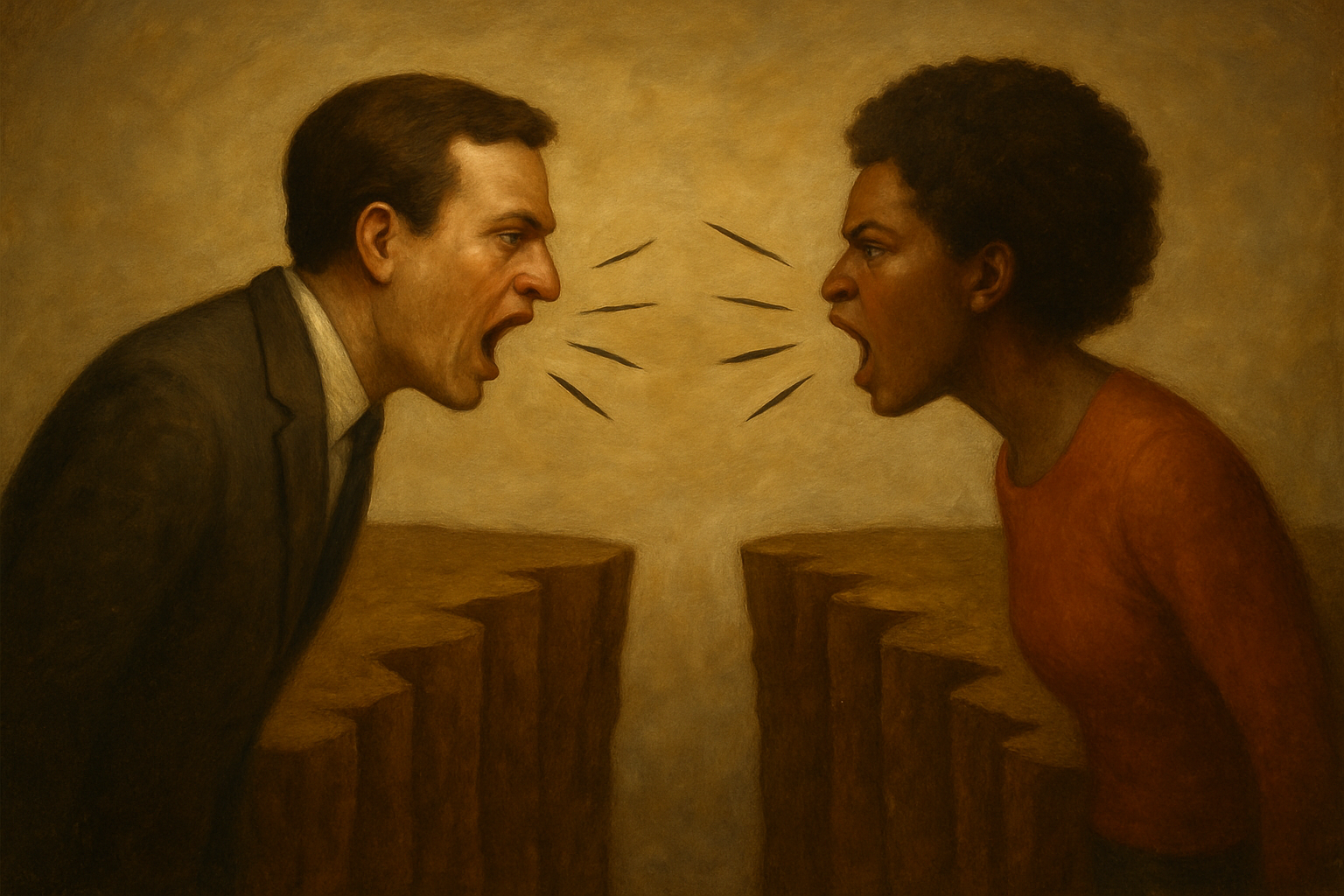
The divide between right and left feels like shouting across the Grand Canyon: it’s exhausting, loud, and usually pointless. We can’t hear each other, and no one is going to cross over anyway.
Debate and compromise presuppose shared values and proximity of belief. If we are miles apart, making appeals to principles not shared, we have little hope of progress. How, then, do we bridge the distance? The short answer is that we have stopped trying, so futile does it feel.
I’m guilty of this myself. The farther the left and right move apart, the more exhausting conversations feel. And the core issue is that both sides have locked themselves into non-negotiable positions. The left is utterly committed to so-called transgender rights, mass immigration, multi-culturalism, diversity, and anti-Europeanism. The right has equally strong convictions on the opposite end of all these issues.
Speaking as a staunch conservative, here’s the problem: I want to preserve the community in which I grew up. I want to see my culture, heritage and language preserved in my city and my nation. I don’t wish to live among strangers in a multicultural society. I think mass immigration is obviously destroying the West, that diversity is more often a weakness than a strength, and that Europe is a majestic civilization worthy of love, admiration, and promulgation. I also don’t want boys in girls’ sports or transgender ideology taught in elementary school.
And I am not particularly interested in debating any of this. These are non-negotiables in my political worldview.
I’ll gladly sit down and discuss tax rates, economic policy, education funding, and healthcare. But I am losing interest in debating the right of European and Commonwealth countries to preserve their unique identity and heritage. I am tired of wasting energy arguing over whether boys and girls can be ‘born in the wrong body.’ And when the usual retorts come—that ‘we are all immigrants’ or that ‘gender is a spectrum’— my instinct is to end the conversation.
I know the other side views my beliefs as racist and anti-LGBTQ. I know they are equally convinced they are right. I know they feel the same frustration talking to me as I do to them.
So what do we do? Across the political spectrum, the left and the right are not talking to each other. The futility of conversation and debate is deeply felt on both sides, and that’s dangerous. Conversation and debate are profound tools of peace because they allow opponents to abstract conflict into a metaphysical realm of ideas and resolve it there rather than in the realm of violence. The more we lose faith in the ‘battle of ideas’ as a mechanism for resolving differences, the closer we drift toward actual violence.
This should concern all of us, and we should be asking the question: how do we begin having meaningful conversations again?